Manuele Fior (Italy) – interview, Stripburger 72, November 2018
Manuele Fior was educated as an architect, but is a comics artist by pedigree. He is an Italian and they are known for their strong visual culture. He has created several long comics and graphic novels, one of which received an award in Angoulême, while his complete collection of short comics has recently been published in the USA by Fantagraphics. As an artist he is in love with his tools and technique and invests a lot of effort into perfecting the latter. He was introduced to the Slovene audience in January 2018 when some of his comics were exhibited in Ljubljana, and this is an excellent opportunity to get to know the ideas and the artist behind his works. (Asking questions: Albahari)
First of all, please tell us something about your formative years and your informal education: when did you start reading comics? What were you reading at that time and which artists were the greatest influence on you? What do we need to know about Manuele Fior to truly understand your work?
I started reading comics at a young age, just as many other kids, but I have to stress that my fascination with drawing mostly came from watching Japanese anime cartoons that started appearing on Italian TV in the 70’s and continue to do so to this day. Just as everybody else I also used to read Disney comics, Marvel superheroes comics, as well as a few French comics. It was the stories of Spiderman and the X-Men that drove me down the path of becoming a comics artist. Later, when I came to learn about, among others, the Valvoline group, Lorenzo Mattotti and Igort, I left all that universe behind and chose a more personal direction.
In a previous interview you stated that you »love pop«. Massimo Colella’s short documentary about your working process shows you in a T-shirt with the Fantastic Four, while one of your screen-savers in the studio featured Spiderman. You even created a few covers for a Bonellli comics series, so it looks like you also like popular mainstream comics. Is that »ironic« or do you actually read them? What’s your view of this part of the comics scene in general (or in specific, if you want)? Are there any innovations or new approaches one can learn from mainstream comics? What is your fascination with them (if you have one)?
There is no irony in that, I still have an emotional affection for these comics and I think that there have been excellent artists who have contributed a lot to comics, such as Miller, Mazzuchelli, Romita, Kirby and Ditko, to name a few. It is also true that this is a somewhat brief phase within the broader mainstream scene which is, by the way, also full of trash. From the storytelling point of view, I think there is a lot one can learn from the American way of making comics which is very compressed and functional. You need to be able to handle a lot of information on a few pages. The visual part has also reached, in some cases, an effective synthesis in which several artists work together on the same drawing (pencils, ink and colour) and create a sense of unity and integrity within the series as well as within the characters. As for Bonelli comics I’ve only contributed covers for a single series, this is a universe that I’ve rarely frequented and don’t know much about.
In the start of your comics career you created shorter comics and published them in Italy and abroad, sometimes even in our magazine. Some of them were written by your brother Daniele. What are your experiences working in tandem compared to working on the artwork and the story/dialogues all by yourself? How do you approach the material: do you stick to a storyboard or do you work without one, improvising as you go? What is your creative process when working on a graphic novel?
I’ve always worked solo, except for those stories that I’ve created with my brother, and I think I’d struggle if I tried to work on someone else’s script. Similar to many other »complete« artists I’ve also developed a very personal, in some sense even illogical working method which helps me create long stories without losing enthusiasm. I don’t use a storyboard, I don’t work on the pages chronologically, but when I focus on a determined topic I try to exploit all of the narrative potential in the story, to squeeze everything out of it until there’s nothing left. I always want my comics to be somehow »updatable« so that I can modify something during the work process. I don’t want to get stuck with the initial idea, I give it space to transform, like a living organism.
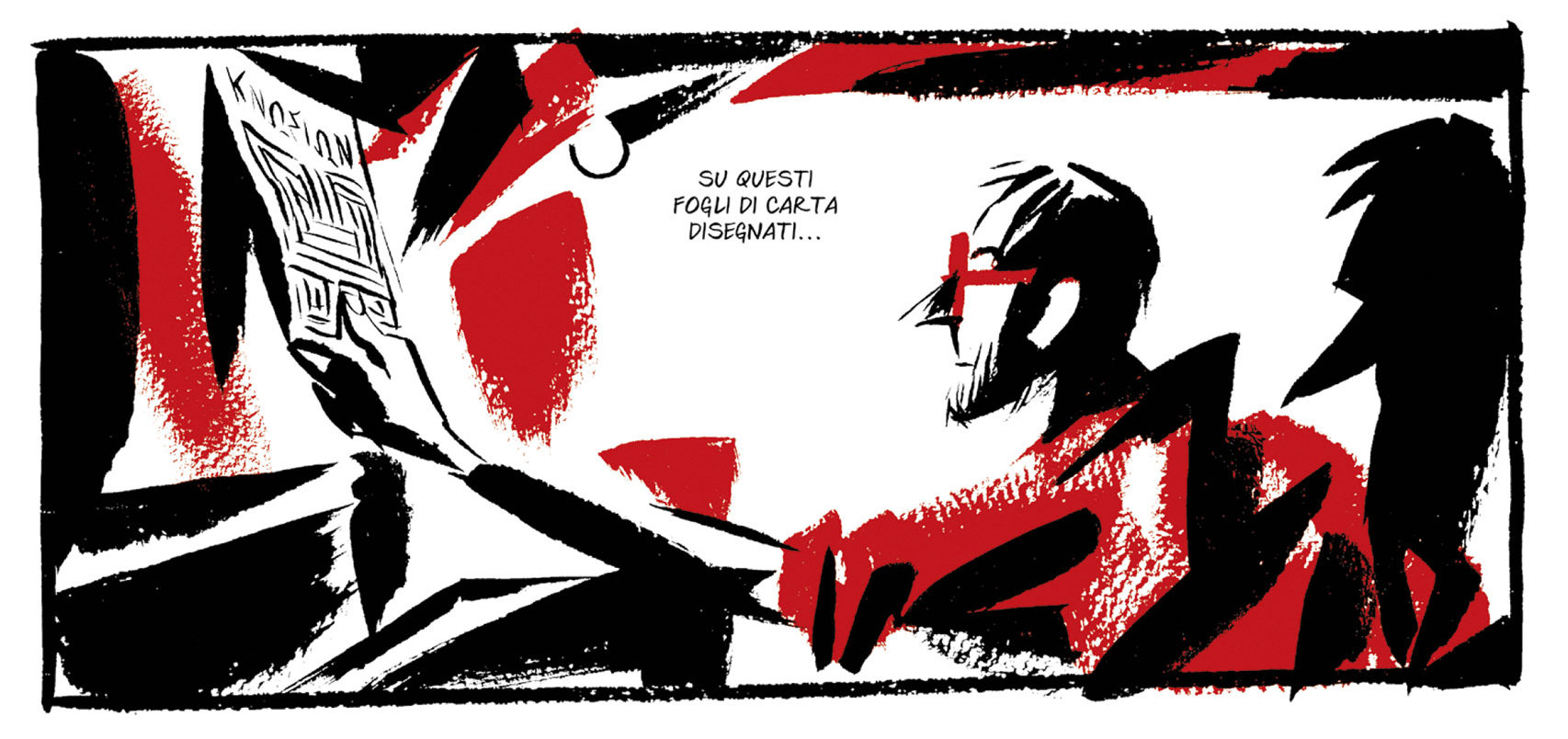
Your third book Rosso oltremare (Red Ultramarine) is created in rich red and black ink that evoke not only fires of Hell but also images from the palace in Knossos where Icarus and Daedalus, also characters in the book, are held captive. This seems a brave experiment in style: what was your intention behind this bold and expressive style with rough and thick brush strokes?
It was an attempt to return to a form of brutal drawing, a non-decorative one, in a way close to cave paintings. I’m not overly pleased with the story, but I believe the drawing works well.
Your comic book 500.000 km per Second won an award in Angoulême. What’s the story behind this book, how should one read it?
In this book I tried to deal with what happened during the years I travelled a lot, lived in many different countries and felt a strong sense of uprootedness. I used three characters to reimagine the choices that differed from those I made in real life, by which I attempted to dismantle my personal biography and make it as universal as possible. Only later did I notice that the story is in fact a very contemporary, generational story of those who left for University and never returned to their hometowns. Of a sort of migration.
You studied architecture in Venice and then moved to Berlin where you started collaborating with avant-verlag. Now you live in Paris, you publish regularly with the Swiss-based publisher Atrabile while still staying loyal to your Italian publisher Coconino Press when it comes to Italian editions. What are your experiences with working for foreign publishers and breaking out of the Italian scene? What do you look for in a publisher, what makes you stay with him and what was your »recipe for making it big« abroad?
Evidently there is no recipe other than to do your work in the most honest possible way you can without thinking about getting rich, but thinking only on creating increasingly better books. There are some publishers I’m loyal to because the growth path of an artist is always tied to his editor and publisher, to the work that’s been done together.
In your penultimate book Le variazioni d’Orsay, in which you dealt with the French artistic legacy from the turn of the 19th to the 20th century, you tried to stick to one technique (gouache) and perfect it, taking to heart the advice of your colleague Lorenzo Mattotti. It is not unusual for ambitious artists to strive for perfection in their technique and meta-modernist times call for precisely this: the return to the supreme levels of technical skill. What are – in this sense – your long-term goals as an artist? Do you follow a motto or a guiding inspirational thought, any kind of rough guidelines for your desired career, or do you improvise as you go?
I’m extremely fascinated by the technique. I want to be able to realize all of the expressive potentials of the tool I’m working with at the moment, whether it is a brush, a small tube of tempera or china ink. I’ve been drawing compulsively for many years because it’s not a path that I see in front of me but a landscape that I explore piece by piece. There are also many failed attempts and a lot of frustration when I am unable to do what I set out to do. However, the amazement over a new drawing, over something unexpected, is always greater and triumphs over pain. I have not completed my work in the gouache technique yet, there are still some aspects of it that I need to perfect and certain potentials I need to realize, even though I have drawn hundreds of pages using this technique.
What else can we expect from you in the future? What are you currently working on or planning to start? Since you’ve already published your illustrations in La Repubblica, New Yorker, Le Monde, Vanity Fair and other important periodicals, what are the next heights you will attempt to conquer?
At the moment my main focus is on finishing my most recent book entitled Celestia: this is my longest and in a sense also most experimental comics story so far. I hope to finish it in 2019.