Tanja Komadina (Slovenia) – interview, Stripburger 72, November 2018
Tanja Komadina is a comics artist and illustrator whose one of the most defining traits, apart from her bubbly wit, is her extremely thought-out and committed approach. She understands the characteristics of the comics medium very well and also in what it differs from illustration, which also represents a huge share of her work. She regularly publishes with several children magazines, draws comics, illustrates books and is in general being quite productive. This is why we didn’t talk about comics only. We also hashed over the situation of illustrators, comics and other artists in our country, but also about football, beavers and about how it is easier to maintain focus on your work if you don’t have a fridge or a balcony at hand. (Ana Bogataj and David Krančan)
In a previous interview you’ve stated that as a child you feared letters and preferred to look at illustrations. Could you expand on this a bit? Did this fact influence your choice of profession?
I used to have problems with reading in elementary school, with following consecutive lines of text, with letters and characters and combining them into words and also with discerning meaning from them. I’ve considered it all one big senseless torture. But I did like the books for their illustrations and since my sister used to read a lot, my childish envy forced me to persist because I was curious about what she was laughing at so much. Now it’s completely different: sometimes I read several books at a time, sometimes I take a break from them and a month can pass without me reading at all. Sometimes I remember what I was reading, sometimes I recall nothing at all, but I do enjoy diving into texts, jotting down references and exploring them, otherwise I wouldn’t be able to do my profession as it requires an attentive reader.
I’ve given a lot of thought to why these problems were there in the first place since I wasn’t diagnosed with anything special. Apart from the basic difficulties with reading and an inability to focus for a longer time there must be other reasons as well: extreme nervousness, shame, children’s sensitivity to their environment, also mistrust that takes up all your mental and emotional space. I did have a very good memory of places, travels, people and spaces and this is how I felt safer. I still often sketch the layout of the place I want to draw before doing it. Yes, this must be one of the reasons why drawing is now my profession: I used to draw, copy drawings and create my own stories on paper ever since elementary school.
You are a comics artist and an illustrator and you often include elements of comics in your illustrations. Once you even stated that each illustrator should create at least one comic book story. Why is that?
Everything you need to know about illustration can be learned from two good comic book pages. You can see how much effort has to go into research and how to make very rational choices in the design of the page while still making the content emotionally engaging and atmospherically alive. By making comics you can realize how much knowledge and skill you need for framing and montage, how to choose and employ the appropriate style, how to properly pace it all, how to use references (costume design, history, psychology, philosophy) that are to be included in the end result, how to reinforce or weaken them so they can work properly. I think reading comics – when you’re paying attention to the combination of all of the above and to the rhythm of reading which is especially important – can help you a lot when you’re working on your own book. Of course in a different way, but diverse reading experiences add up and come in handy with your own visual creation.
You’re very productive and you work for many different youth magazines and publishers. Are you able to afford any days off or holidays or just creating for your own sake, apart from commissioned work?
The summer vacations are too short. I can only rarely afford an extended weekend free from work during the year. Sometimes I get overworked and I lay down for a day or two due to lack of sleep. Sadly, I’ve been drawing very little for my own sake in the last four years. I make notes, photocopies, develop ideas of what else I could do. Nowadays, I need to make a deliberate effort to stop and rest my hand and just do nothing from time to time.
Your continued overworking has recently led to an acute wrist tendon inflammation and you had to go on sick leave for quite some time. How do you view the position of illustrators in our society? What is their biggest issue: low fees, tight submission deadlines, self-employment without proper paid sick leave or vacations?
When it comes to the field of illustration and children’s and youth literature I’d like to emphasize that we have quite a few extraordinary editors. Talking to them and working with them is invaluable for one’s improvement and for maintaining the quality of illustration. It is much easier to start your professional career in Slovenia than it is abroad, but later on it is much harder to negotiate better conditions and get better texts to work with.
Otherwise the situation for illustrators is not very good in Slovenia and I hope it will improve with better connections between illustrators and comics artists. First in the sense of broader integration with other fields and by making artists aware of the fact that negotiations and acquiring knowledge help us achieve better working conditions in our profession.
We’re absolutely underpaid. This is why we’re constantly working on something, if we’re »lucky« to have enough commissions, so it’s even harder to get additional training. The current legislation framework doesn’t allow for any security when we’re sick or for our retirement. In Slovenia, with the status of a self-employed illustrator it is impossible to survive if you’re on sick leave. You then need to rely on your relatives or your eventual savings.
The predicament with this status is a broad one. One of the problems with sick leave is that you get paid for it only after 30 days of sickness. The status, based on the recognition of your excellence, allows you to pay the minimal contributions for medical and social security. At the same time it also puts a top limit on how much you can earn which is suffocating and stifles creativity and in the long run it leads to miserable pensions of top artists because, thanks to this – apart from the low pensions – they’re not able to create any savings.
Burnout is too common in this line of work since it requires constant focus, precision, self-discipline and often also working overtime. The working process is slow and time-consuming while if you create newspaper illustrations it can be concentrated and short. It is possible to keep up with all of this, but only as long as you have good working conditions, while you’re young and healthy, while you live at home or someone is supporting you financially. It all changes for the worse when you need to take care of your family and home and you have no other source of income. But in theory, in the broader sense, you could become one of those who can cope with all this and become well-paid at home and abroad.
After your recovery, how come you decided to illustrate the Gobčko in Hopko book in coloured pencils that require even more hand gestures than brushwork?
First I read the book several times and only then do I decide which one of the techniques I’m familiar with I’m going to use. In this case I thought that doing it in brush would be making it too soft and unrealistic. That’d only emphasize emotions that have already been described and reinforced in the text itself. The boy in the story draws a castle at the end of the book, so I’ve decided to frame the illustrations across the book from a long shot to a close shot of the boy’s drawing made in coloured pencils/crayon. The motif of this drawing is the reason why the two boys have a quarrel but also the reason for their reconciliation later. The book is intended for pre-school children and these coloured pencils invoke kindergarten drawings.
As for the hand it is the hardest when I’m using a pen, when I’m working on a computer using a digital stylus or when I’m typing. In that case I have to flex and relax the palm and the fingers and cool them off with ice.
Otherwise you usually use pen and colour ink. However, if I’m not mistaken you’ve used the computer for the first time when colouring the Cankar comic book. Was a tight deadline the main reason for this? The end-result is very convincing, by the way.
Yes, that too. The project had an extremely tight deadline so I couldn’t afford any mistakes and repeats. The other reason was that I wanted to add more colourfulness to the book. The colours are meant to reflect Ivan Cankar’s childhood playfulness and mischievousness and to counter the gloom of the original texts and of his family’s hard times.
Your V temi se mi vse čudno zdi (In Darkness Everything Seems Strange To Me) comics story, published in the Cicido magazine, marks a departure from the conventional comics form. How come and what were the responses to it like?
This is a magazine for pre-school children so I decided to create the main character, who haunts in the dark, bigger and clearer. I’ve surrounded it with 4-6 frames for intro and outro. The children are confronted with frames in sequence, simple framing and speech bubbles with simple sentences or interjections. In visual terms it was mostly praised, but children reacted to it in different ways: some liked it, some didn’t. Haha. I even heard that two children from the same family started fearing the dark as they didn’t know something could be hidden in it before they read the story.
The majority of your work is dedicated to children. Is this because you prefer creating for this specific audience or is this a mere coincidence? Would you like to create something for adults as well?
Yes, I really do like to draw for young readers and for now I can see myself in this. Truth be told I don’t think too much about the readers, everything happens spontaneously and this is how I preserve a lot of my creative freedom. However, I would like to do something for adults since any change in content is welcome, just like any other texts for the young readers. To put it simply: I wouldn’t be able to create only funny or only sad books.
Your comics book debut titled Fino kolo (Cool Bike) is generally intended for young readers but the topic it covers is a very adult topic – refugees. It was your decision to use the short story by Manka Kremenšek Križman. At what point while reading the story did you realize that this could become a comics story and how did you go about adapting it to comics?
I was reading many short stories by Slovenian writers at that time in search of one I could adapt into a comic book, one that would strike me so much I’d actually complete the comics story. When I first tried to make a longer comics story I knew it had to be emotionally close to me for me to finish it at all. I think I instantly knew this was the right text, so I read it several times for confirmation. Then I contacted the writer and asked her if I could use her story and had some more questions for her. I promised her I’d stick to what she’d written. Then I xeroxed the text and arranged the pages into a new sequence because I had to change a few details in order for it to work. I underlined all the sentences I wanted to use in the comic and adapted them a bit while drawing the pages. I started with small quick sketches with which I defined the page count and then continued with more elaborate ones that included the text too.
Do you generally prefer working with your own or someone else’s script? What kind of experience do you have with our script-writers?
I’d love to be able to write stories as well. For now I have had two excellent experiences. I’ve collaborated with Boštjan Gorenc Pižama to create the Moj lajf (My Life)comic book. We met a few times and agreed on the concept first. Then we exchanged emails and agreed on the working process before he started writing the script. He sent me a script that already included all the scenes, directions, dialogues and other accompanying texts, as well as additional photo material where it was needed. We agreed that I could change the scenes a bit if I found I could improve it visually. I even asked him for a few photos (e.g. of specific acolyte dresses from a certain year) because he’s much better than me in searching the internet and I was very short on time. After completing them, he sent individual chapters for me to read, and then we went through them. When I finished drawing or colouring a chapter I would send it to him for review. Sometimes we changed some visual details or added something in the dialogues. Our creative worlds are not very similar, but luckily everything went well, also because it had to.
Maša Ogrizek and I have been working on a children’s series for the Galeb magazine with elements of comics (Zgodbe o pohištvu and Zgodbe o aparatih (Stories of Furniture and Stories of Appliances)). The process and scriptwriting were very similar to making comics. A monthly interval gave us much more time and we both did our own part. Maša first introduced the main three characters in the first episode, I drew them and sent them back. Then we established the episode sequence and titles. After that she wrote the texts for the individual episodes with precise instructions and a sequence of images as well as photo material since we had some historical scenes. I created some quick sketches to see how they fitted the magazine format, coloured them and sent them to Maša for her to review. Within a few months of collaborating we figured out the characters and found a way to work together, so the work was being done increasingly faster and more simply and was becoming more fun compared to the first months.
Generally I think that such an approach to scriptwriting and collaborating is still rare in our country (except for a few established duos) and we’re only learning how to do it as we go, through experience and discussion. Of course, it all depends on how you work it out with your partner and how the two of you work together.
Comics require a more frequent and intense collaboration than an illustrated book, for example. I agree with my colleagues who have noticed that the scripts look more like a normal story than a comics script, that the dialogues are often too long, that some instructions are redundant and that there are no visual clues to clarify the script. This requires more work from us which I don’t find acceptable. After all, the writer won’t be colouring my drawings after my inking.
One of your clients happened to be the top-league football club NK Domžale who commissioned an illustrated book entitled Bober Nogometaš (Beaver Soccer Player). What were you attracted to in this case, the soccer or the beaver?
The beaver 🙂 Mostly because they said I could have a few speech bubbles and that I could make the book look »comicsy«. I also added some dialogues in bubbles (like when the father tells his son, a soccer player: »Listen, son, one needs to chew through life!«) which the writer reviewed and added or fixed something here and there. The main character had to be visually based on the mascot of the club and the project was the result of a collaboration between the Miš publisher and NK Domžale.
You used to publish short comics on your blog, witty sketches from your private life. Does this mean you are going to make something autobiographical in the future?
I write down my ideas and then I am taken aback and amused by my own awkwardness, silliness and fear. However, the blog features my non-proofread sketches made during my breaks. I’ve set myself the goal to finish each of them within one hour (this was before my hand injury). I do enjoy the free layout of the frames, but these sketches are not good enough for a book. My plan is to do it all from scratch in 32 pages of short comics.
Your partner Igor Šinkovec is also an excellent illustrator. Do you help each other a lot? Do you create in the same space? What does your working day look like?
When it comes to drawing, we do talk a lot about it. We help each other during the first early phases and we always show each other what we’ve done. We have a working room at home and a small rented studio nearby. Igor needs superior lighting because he works in the gouache technique, so he mostly paints at home, while I sometimes go to the studio and work there. Sometimes we prepare some sketches and then we both go there to draw. The studio is a place with nothing but a table, no fridge or balcony, so you can focus on your work for several hours.
A morning routine is necessary, mine is very relaxed. Every day starts with a long coffee, some reading, my cat who’s fishing for petting and a short run or a series of exercises. My peak productivity is between 9AM and 5PM.
Ever since my hand injury I’ve been drawing throughout the entire day with breaks and several hours less than before. I dedicate a lot of time to preparation, gathering ideas, reading (internet, articles, books, texts), searching the internet or a library for references. When I’m in a routine phase and I’m not distracted by it, I listen to music or radio, but that’s not very often. I check my to-do list every day to add and remove tasks. I don’t use my mobile phone fully, I still prefer having a small notebook. What I don’t like is sitting long hours so I am constantly stretching, doing squats and looking forward to going for an evening walk or run across Golovec. Sometimes this is the time when I finally come up with a solution to a problem that’s been bugging me since the morning. After 7PM I’m out of energy and trying to wrap up the day. I’m not a night bird anymore. We both fall asleep while reading or watching a show shortly after midnight.
You said in an interview for the Delo newspaper that you have plans to create an illustrated book all by yourself. Can you tell us more about this or any of your future projects?
I’m researching and reading and writing down the story just for myself, simply to know what to draw. Only later will I have a presentation for the publishers. I will tell you more only if the project gets the green light, but the path in that direction is a long one as I still have a lot of reading to do.
As for solo projects I have in mind this illustrated book and an animation while I’m still developing two more ideas for a comics script. Igor and I have some shared ideas as well. I don’t know whether any of these will be realized, for this also depends on the commissioned texts I’m working on. However, I do feel the urge and need to make something on my own and most importantly: at my own pace.
Not long ago a theatre play entitled Moj lajf (after my comic book by the same name) for which I designed the visual image and scenography premiered in the Maribor Puppet Theatre. Just recently my second book from the Trio golaznikus series by Andrej E. Skubic was published. The book by Nataša Konc Lorenzutti for the Miš publisher is in preparation for printing. At the moment I am illustrating stories for the Ciciban and Galeb magazines and for the Bobri festival as well. Then I have some more new books for 2019.
Would you be so kind to briefly explain the comics that you made for this issue of Stripburger?
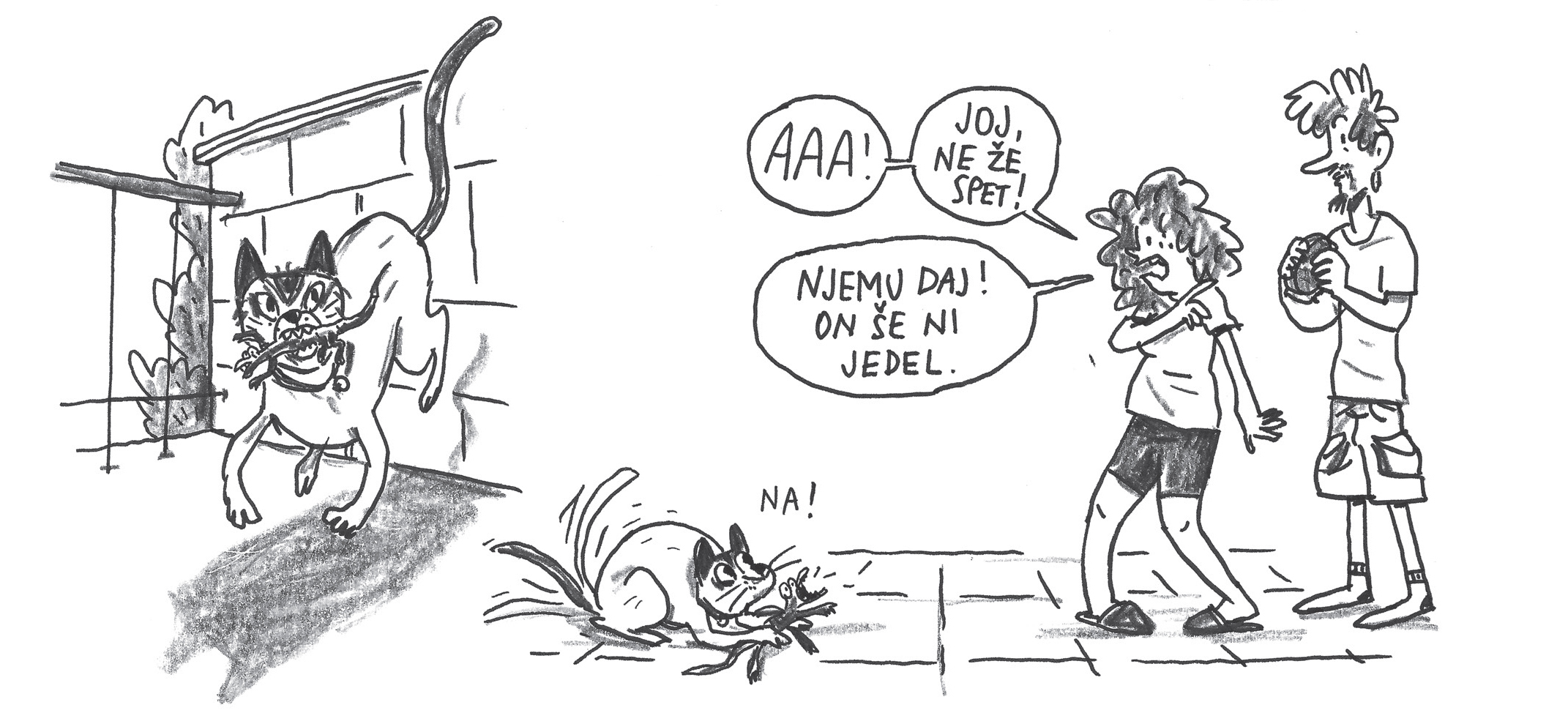
I’m seizing the opportunity to submit two real-life comics stories. This is how it all started: I was discussing the idea of getting a dog with my partner, but then a cat entered our home. It all began when we started taking care of the cat that had to be quarantined in order to avoid contact with other cats as it had the cat plague. The cat had recently been sterilized and was very weak. We’d just moved into another apartment so she was staying there in a big cage in the middle of the living room. She did little more than sleep for three months. The cat survived and stayed with us and this was a new beginning that encouraged me to draw. Our current apartment has a balcony on which the cat spends a lot of its time during the warm season. The comics here come from the series of the cat’s balcony adventures.