Caroline Sury (France) – interview, Stripburger 70, November 2017
Looking back at the diverse selection of Stripburger’s interviewees, one quickly realizes that female artists have earned this privilege on much fewer occasions than their male counterparts. Don’t worry, we’re not going to discuss the reasons behind this at this point in time. Instead, we’d like you to get closer acquainted with an artist whom we’d have a hard time presenting as an exclusively comics artist, since she has several different talents in other visual arts, however we can confidently assert that she »has balls«. There are many things behind her, but also many in front of her. She did not merely kickstart the Le Dernier Cri collective and co-create Marseille’s notorious underground publisher program with Pakito Bolino, she’s also an unbridled, untamed and prolific artist, the author of a rich & recognizable graphic, drawing, cut-out and »who-knows-what-else« opus. She lays low in the underground that teems with a rebellious atmosphere: a subtle, but a visually loud one. The insightful edginess of her drawings (and her scissors) bravely and boldly dissects herself and the macho world surrounding her. After fifteen years she is going to revisit Ljubljana in December, this time with an independent exhibition in the Alkatraz Gallery and as a special guest and jury member at this year’s Animateka, the animated film festival. It is about time we finally get to know her better!
Interrogatress: Tanja Skale
Many professional illustrators claim that drawing is the leitmotiv of their lives that begun in their childhood. Does this hold true in your case? Was drawing your first love or passion, or was it music or something else?
No, I can’t remember anything like that. But at the age of 14 I was convinced I wanted to have an art career. School was so boring and I was interested in creating things with my hands. My passion was music! Me and my younger sister were crazy about music, we were totally in love with Robert Smith and Ian McCulloch. Then came Bauhaus, Siouxsie and the Banshees, Joy Division, Kas Product – a great French band from Nancy, Marquis de Sade, Tugs, Bérurier noir and many others. Imagine my great disappointment when I was 20 years old and my hair didn’t want to stand up straight on the top of my head…
Which artists did you admire the most and who was your greatest influence?
Jean Dubuffet, Gaston Chaissac, Le Douanier Rousseau, Otto Dix, Georges Grosz, Frida Kahlo, surrealists, dadaists, COBRA …
We mainly know you as the co-founder and long-time contributor to Le Dernier Cri (LDC), the legendary alternative publisher, graphics workshop and art collective. Could you tell us something about the beginnings of this group, how it all started?
I was in Bordeaux making a silkscreen portfolio with my drawings, singing in the band RWA, my boyfriend Vinz used to play music with Pakito Bolino and write for the same fanzine, Hello Happy Taxpayers (HHT). I drew for HHT too and that’s how I met Pakito. In 1993 we moved to Paris together and once we found a silkscreen studio in the Parisian suburbs, we started creating our own things. We mainly worked together and other illustrators came to help: Kerozen, Pigassou, etc. We decided to publish people who were not published by the mainstream. That was easy, as most artists we knew were like us, involved in drawing and music. Most of us lived in the same area, Ménilmontant, and we had a great time!
With Le Dernier Cri, you’ve collaborated with numerous underground comics and graphic artists from all over the world. How did working in an art collective influence your artistic growth and your works?
When you work with such an array of artists, you learn a lot about different universes, techniques … I truly appreciate Nuvish Mircovich, Ludovic Levasseur, Renhard Chebner, Stumead, Matthias Lehmann and Daisuke Ichiba for their obsessive drawings. Ludovic Levasseur introduced me to etching prints, which was a very important moment in my artistic life. He asked me to create a series of etchings and this greatly influenced the way I looked upon drawings.
The work I have done is precise and imaginative. Salon de coiffure and Tsantsas are projects that provided me with another way of drawing, a deep way, from the inside and from my emotions.
Can you highlight any specific LDC projects or collaborations that you enjoyed especially?
I have met so many artists while working with Le Dernier Cri! How can I possibly choose someone? I love them all! I love the differences, I love to be surprised, but I guess I could say I love Raymond Raynaud, who has unfortunately passed away. He was 75 years old when I met him, and he was so nice and open minded, and his art was strong and crazy!
I really loved making the mask and puppets and animations for the Hopital Brut movie, and we made a crazy scene with Jonathan Rosen for Les Religions Sauvages: the sea and a boat in a room of la Friche (Friche la Belle de Mai, an arts centre in Marseille – Ed.), it was Hollywood Invited by the Fumetto festival, we built an exhibition in a prison in which every cell had a »sick« LDC artist installation, with all the elements that were used in the movie Hopital Brut.
In 2007, I was in Los Angeles for a LDC exhibition in Sinamon station in Santa Monica, and the curator showed me his collection of works by Manuel Ocampo, beautiful paintings with the cockroach king! I was in the house of Buzz Osborne from the Melvins, a pure cabinet de curiosité with a collection of Japanese monsters that was way better than mine!
I also visited Bolivia with LDC, Pakito was very uncomfortable at 5000 meters altitude. I love the mountain where you burn offerings for your car not to break down, I love the cholas. They are involved in selling everything on the local market, so they’ve got money, they are in control of their lives, they look weird and nice in their hats, jewellery, dresses…
It was incredible how much I did at that time! It is truly insane! I can’t focus on a single thing. Lots of work with various editions and animation movies, lots of people from all over the world coming through the LDC studio, exhibitions, trips … my trip to Ljubljana for the City of Women festival was very nice by the way! And I’m very happy to come back!
You’ve mentioned Bolivia … Are indigenous arts an important source of inspiration for you?
All natives from the American continents and cultures inspire me, from North to South: Mexican Otomi with the cut-out paper shamanism, Huastec art, Hopi and their kachinas, New England coast natives with totem poles and masks, Inuits with their masks…
What about your fascination with Japanese monsters? Tell me more about this!
I was always fascinated by China and Japan, but Japanese monsters are so imaginative, crazy in their forms. Pakito and I had a nice collection. We bought them in Bimbo Tower in Paris. I guess the collection could have grown now as he is often invited to work there. I just dream about this country while watching movies and reading books about Asia.
Your work draws from the tradition of art brut. Critics describe your unique drawing style as wild, raw, chaotic, unbridled, even aggressive and uncanny. Are your drawings created in this fierce, spontaneous, momentary, impulsive and unbridled way, as the style suggests? What is your creative process usually like?
I’m a very concentrated person. I’m a nice woman, I smile a lot and I am a good worker. I say yes and I’m polite most of the time. I do what people around me expect me to do, but I feel like a volcano inside. My drawings are places in which I will show my pussy, have my own therapy session. The problem with me is that I publish every single drawing and create books that show my problems, such as Bébé 2000, Cou tordu, Drôles de dames, or my last opus, La Menteuse. I’m extremely indecent on paper!
I spent a part of last summer in a residency in a beautiful house in the small village of Reillanne where I drew my new comics, Un matin avec Mademoiselle Latarte. I spent all of the days in a small room with nothing on the wall, for I choose the monk’s room. It was just me and my brain in this tiny, white, empty and quiet room. All of the characters from my story were there, the entire landscape, my whole little theatre. It was a perfect summer!
One of the characteristics of your work is that you don’t limit yourself to a single medium, but you experiment with different techniques and approaches (ink drawings, watercolours, silkscreen printing, etching and other graphic techniques, comics, dolls, cut-outs …). Does this mean you’re constantly searching for something new?
I like changing my tools; I get bored if I do too many cut-outs. So I return to fabric and make a doll. In order to feel free, I don’t put too much pressure on a single technique. I believe in modesty and honesty. And moving on.
In spite of all this, it seems that drawing forms the basis or the framework of your opus. Would you agree with this?
Drawing is the brain expressing itself; I love it more and more. For the past 10 years I’ve been drawing self-portraits as a psychedelic experiment. Not taking any drugs, just jumping into an unknown area of my brain.
Your works are very personal. Your comics deal uncompromisingly with autobiographical themes, even those extremely intimate, painful and as such controversial, as these issues are usually not dealt with publicly. For example: Frida Gastro is a »portrait« of your abdominal infection that includes all the gory details, Bébé 2000 (L’Association, 2006) is a brutally honest and non-embellished comic book about your pregnancy and birth of your son Oscar and your relationship with your partner, while Cou tordu (L’Association, 2010) is the continuation of the dissection of your everyday, of your physical and emotional pain, although the borders between reality, nightmare and imaginary worlds are usually blurred. Is it hard to disclose your intimacy to the world in such a way? Or is it a way of confronting your life, your pain and your nightmares and liberating yourself, a catharsis of sorts? In short, do you see drawing as one of the ways of establishing a relation with yourself, with what surrounds you and life in general?
You understand me extremely well!
Is there a boundary you’d not cross? Are there things you’d never address in your works?
I don’t know and if I knew I won’t tell you.
In an interview for Stripburger Julie Doucet said that autobiography can become »a bad habit, a trap and a mental disease«. Consequently she’s ceased making comics and focused on other, non-narrative visual forms. Do you have a similar experience to her?
Drawing about your life is extremely risky; people love it and hate you. But I won’t stop! My next comic speaks about how I tried to escape a psychopath.
Could it be that because creating comics narratives is demanding and requires greater precision, effort and more time compared to, let’s say, creating a series of illustrations on a certain topic or cut-outs, that you seem to be so heavily involved in recently?
Comics certainly are a lot of work! Your brain is very active which is why I love doing this kind of work in an art residency. You are focused and quiet. You just eat, sleep and draw.
Speaking of cut-outs, you seem to have turned towards a more stylized approach (silhouettes, clear lines …). What led to this? Is this »drawing with scissors« (Matisse) some sort of an exercise in limitation and precision? Could it represent a channelling of chaos, of complete control over your artistic work?
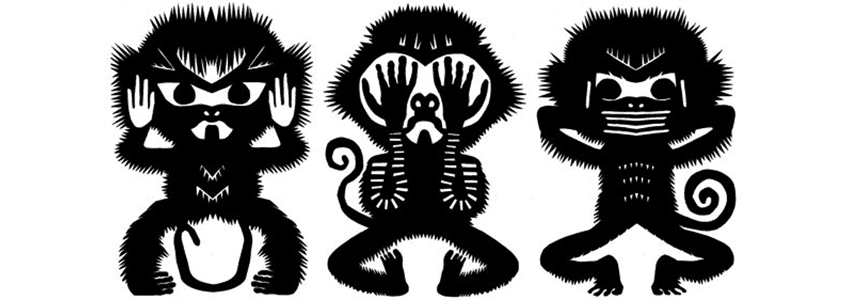
I’ve started creating cut-outs with my son, and I found something in cutting, something inside me, very sad and hidden. My heart needs to be protected and I cut armour helmets, arms, masks, disguises. I experienced it as very peaceful and inventive, so I made a lot of them. I always had new ideas coming from my scissors. I was inventing as I went along, no previous drawings or sketches. And these black forms were so powerful, like talismans, amulets, grisgris, they had a shaman status. The symmetric way in which they were done gave them totemic power. They are sculptures for which you take out the black material.
Female figures are often the main focus of your compositions. These are figures with child-like proportions, large heads and eyes, set in deliberately teasing and exhibitionistic poses. This tension between the naïve and infantile style on one hand and sexuality on the other, creates a peculiar comic effect, irony and ambiguity. Is there, in the background, some kind of toying with eroticism, a wish to break down taboos, conquer the seriousness with playfulness?
Maybe I’m still a child on the inside, playing funny adult games.
Do you see your work as a kind of feminist engagement?
Of course I do! I always have without knowing I was doing it. I was always involved in female sexuality, drawing pussies, these little hidden mystery places in our body. I also sung in this band in Bordeaux. My French texts spoke of my struggles against the first male singer who was singing bad things about women in English. In Drôle de dames all my drawings are about open pussies, masturbation, all these hidden things I needed to show. But they are not aggressive, they are women playing with their bodies.
Can you tell me more about the Vagina Mushroom, a women-only anthology you edited? How did it start and why did it end after 3 editions?
Vagina mushroom was a silkscreen printed book. I started it when I met female artists from all over Europe during a LDC exhibition: Ulli Lust, Anne Van der Linden, Elina Merenmies, Mirka Lugosi, Pirgetta Brender, etc … and was going to Un Regard Moderne in Paris, a library where you could find every underground borderline artist book, where I met Georgeanne Deen and Stumead. When I started drawing and making books with LDC I was almost the only woman of my generation doing this kind of free drawings. The anthology ended because LDC had so many projects mixing everybody – men and women – that it was not necessary to do a special women project.
You’ve been living and working in Marseille for over two decades now. This city regularly appears in your works, for instance in comics such as Bébé 2000, Cou tordu, Couscous sardine, and illustrations you’ve created for a local newspaper (Marseille l’Hebdo). You have also illustrated a book on the history of the city (Marseille, quelle histoire!, Gaussen Éditions, 2012) … Does Alexandre Dumas’s famous quote that Marseille is the hub/meeting place of the entire world also hold true for the art scene in Marseille? How does it differ from the scenes in other French cities? Do you like living and working in Marseille or would you want to move somewhere else?
I’ll stay in Marseille. It’s a good place to work, my family is here. The scene is good. Lots of concerts, exhibitions … people are very bad, they are not nice, and they are stupid. It’s hard sometimes, but it keeps you awake! Fortunately some people are ok! It’s a crazy city in which I find endless inspiration. I couldn’t live without Marseille. It is my life.
Since you’re a jury member at this year’s Animateka festival of animated movies, I’d like to know what is your stance as regards this art form. With LDC, you’ve created a few animations; do you plan to create any independent works in this field?
I returned to animations with my companion Ludovic Ameline. He is my set designer at exhibitions and works with me in animations. We have made a few short movies, very short indeed. I like to construct an atmosphere for my exhibitions, and with Ludo we made all these animations mainly to show the drawings and cut-outs in a different way. It is like a drawing but with sound and effects. We want it to be more like sharing an experiment.
Your exhibition that will take place in the Alkatraz gallery in Ljubljana in December will also include a performance. Can you tell us a bit more about this? Is this an upgrade of your regular artistic endeavours? Maybe some kind of ritual that allows you to have a more direct contact with your audience?
Together with Ludo and Nico (Nicolas Binot – Ed.) we will enact a ceremony using a shaman ritual and advanced technology such as virtual reality. We want the exhibition to be more than just something hanging on the wall. The cut-out paper workshop will be a part of the ritual. As you can see, I like to use new tools to show art!
What are you most interested in as an artist at this moment? What are your plans for the future?
My new comic book is almost finished, I’d like to finish it by the end of the year and publish it in 2018! It’s about my life with a psychopath and, as it includes the delicate subject of harassment, I disguise myself as Miss Pie and the guy as Psychojumbo. I had so many crazy situations and dialogues with this man, and the subject is unfortunately very fashionable these days… women captives in a mental prison built by a narcissistic pervert. After 3 years of craziness I managed to escape from him, and I decided to make these comics to show how it works. After the LDC experiment and Psychojumbo, I have won many life points in the macho game…
I’m also working on a show with a street theatre. 13 big cut-outs for a shadow theatre, handled by dancers in the fashion of Cambodian street artists. This is another way of animating new characters!